Five Essential Documents Every Artist Must Have
You hear it from other artists: "I'm not an accountant, I'm an artist." Comfortable phrase. Lets you avoid uncomfortable conversations about paperwork. But it builds on sand. Without documents, your work is coloured paint on material. With documents, it's an asset with value, history, legal protection. This is the difference between "I make work" and "I have an art practice." When a collector asks about provenance, without documents you're defenceless. When a gallery requests cataloguing information, you have nothing. When a museum wants to research your archive, you're scrambling in chaos. In five years, when you need information about an important work, it simply doesn't exist. Documentation isn't bureaucracy. It's the infrastructure separating artists who improvise from artists who have a system.
First Document: Artwork Passport
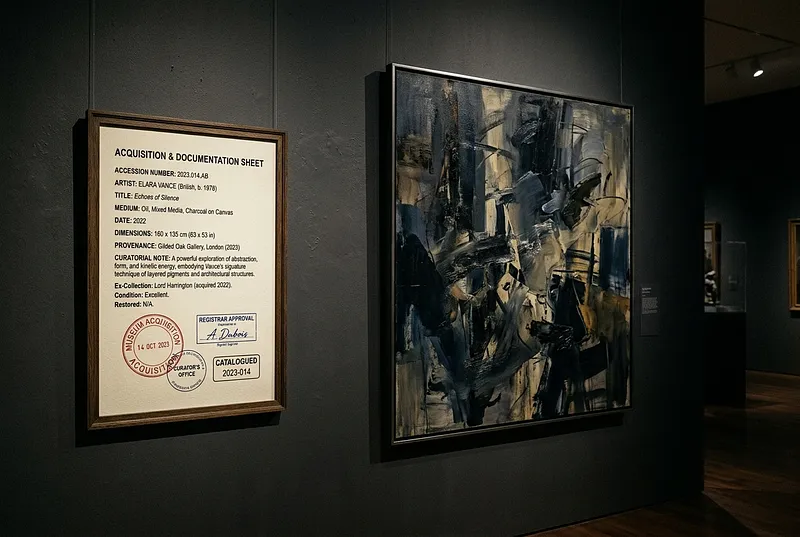
A standardised data set for each work. Artist name, title, year, medium, dimensions, inventory number, series, edition. Everything together. Think of it as a birth certificate for a painting. Without a passport, a work floats in emptiness. You can't quickly provide information to a gallery. You can't accurately describe it for a catalogue. You can't distinguish one work from another when you have hundreds. You can't prove authorship when needed.
When your archive grows beyond a hundred works, it becomes chaos where everything valuable gets lost. Golden rule: no work leaves the studio without a passport. Not to an exhibition. Not to a showing. Nowhere. Five minutes of documentation protects your work for years to come.
Second Document: Certificate of Authenticity
Your sworn statement: you created this work. It's called a Certificate of Authenticity and it's not merely paper. It's a legal document making your work legitimate on the secondary market. Without a COA, a serious collector won't buy. A gallery won't take it on consignment. An auction house won't accept it. Insurance won't cover it. When a collector ten years later wants to resell your work, without this document they can't prove it's authentic. COA is what legitimises art on the market.
A certificate must include: your full name, work title, year, medium, dimensions, number, edition, your signature, date, and a photograph. Some artists add holograms or QR codes for expensive pieces—this adds security against counterfeits. For standard work, a simple document suffices. Critical mistake: issuing a COA only if the buyer asks. Wrong. Issue it automatically with every sale. One work, one certificate. A series of ten, ten COAs. It becomes part of the sale, like an invoice.
Third Document: Inventory Register
Your operational database. A complete register of everything you've created. Each work, its number, its status: in studio, on exhibition, sold, in collection, in storage, on consignment. Plus photographs and prices. This system answers everyday questions: where is that work? How much does it cost? Do we have a photo? Is it already sold?
With five works, this seems unnecessary. With fifty, helpful. With two hundred, invaluable. Inventory is how you manage chaos and allow galleries to trust you with consignment work. Format doesn't matter as long as it allows filtering and searching. Excel with columns (number, name, year, medium, dimensions, status, price, location, date, photo) is the bare minimum that works. Platforms like Artfond do this automatically: every work you upload immediately enters the register.
Golden rule: update immediately. Sold a work—change status to "sold". Exhibited—record the date. Returned—mark it. If you postpone "until later", the register becomes outdated and loses all value. A gallery relying on your inventory needs to trust its accuracy completely.
Fourth Document: Sales Documents
Every art sale is a financial transaction requiring documentation. Invoice, delivery certificate, purchase agreement (for large amounts), receipt. Everything proving: when, to whom, for how much. Why? First, for your records. If you're self-employed or planning to be, you need documents for tax purposes. Second, for price history. A sequence of documented sales demonstrates growing value. If you show consistent price growth, galleries take you more seriously and collectors pay more. This is a documented fact across market research.
Third: provenance. Sales documents form a chain of ownership—from you to the first owner, from them to the second. This chain is the basis for legitimacy on the secondary market. A work without provenance is under suspicion. With documented provenance, a work becomes valuable. Auction houses won't touch work without clear ownership history. Minimum: issue an invoice for every sale and keep a copy. A delivery certificate for physical transfer. An agreement for larger amounts. Store everything digitally and, ideally, in paper form too (scanned and in cloud storage).
Fifth Document: Exhibition Documentation
Every exhibition requires detailed recording. Opening invitations, catalogues (most important), photographs of the exhibition, press releases, review articles, participant lists, informational materials. All this material supports your CV and proves your exhibition history. It's also material that later goes into museum databases, research publications, biographical references.
In five years, you definitely won't remember a group show from 2024. What was it called exactly? In which city and venue? Opening and closing dates? Who else exhibited? Were there press articles? But if you have a folder with the catalogue, exhibition photos, a copy of the invitation, and press clippings, all that information is at hand. This saves hours when updating your CV, applying to new competitions, or preparing a portfolio for museum enquiries.
Storage system is simple but critical: a separate folder for each exhibition. Name it: "2025—Exhibition Name—Venue Name". Inside: the opening invitation, catalogue (scanned if paper), photos of the exhibition from all angles, photos of your work in the space, any press articles or reviews, list of all participants (if a group show). If the exhibition included lectures or discussions, keep recordings or notes. After each exhibition, immediately update your CV, adding a new line to your exhibition history. Don't postpone. What's obvious now becomes a puzzle in three years.
When to Start: The Answer Is Now
Every day without a system is information evaporating from memory. You can't remember how much you sold that work for in 2021? Don't know who bought that triptych? Can't find a photograph of work already in a private collection? These are typical situations with one cause: no system. Don't wait for the perfect moment. Even simple Excel beats nothing. Start with what you have: list works from the last year. Give them numbers. Record statuses. Collect photographs. Then maintain it after each new work, each sale, each exhibition. It becomes a habit, like washing brushes.
System: Discipline That Pays
Every documentation gap costs you. Hours later, scrambling through hundreds of works with inconsistencies. That large triptych without a passport can't transfer to a collection without documents. That sale five years ago without an invoice can't be included in price history to justify a new price. The exhibition you forgot to record in your CV simply vanishes from your history. But with a system, every decision and step is documented and ready for use in any context.
A system begins simply: a spreadsheet for works, folders for exhibitions, folders for sales, folders for certificates. Thirty minutes to set up your folder structure. Then: discipline. Every time a work leaves the studio, every sale, every exhibition—update the records. Five to ten minutes per work. Annually, that's 50–100 hours of investment. In five years, you'll have an archive supporting museum proposals, international participation, objective pricing strategies. This isn't time spent on bureaucracy. It's time invested in your work's future.
Documents as Investment
Documents are the memory of your practice. Without them, in five years you can't prove authorship, value, or history. With them, your career has a foundation for years. Artists with long careers have archives that outlive them—collectors, museums, researchers find works in catalogues, restore provenance, include them in catalogue raisonnés. Other artists leave chaos impossible to untangle, so their works are lost to time. Choose the first path. It's not technically complicated. It simply requires discipline from day one. And this discipline becomes your competitive advantage on the art market for years to come.
A system of documents is what separates a hobby from a practice, a practice from a career, a career from a legacy. Choose documentation from day one.