The Artwork Passport: Your Work's Identity Document
You created a work. Weeks of labour. Hundreds of pounds in materials. Nights of experimentation. Then it sits in your studio. The first serious buyer asks for details and you go silent. Dimensions? Technique? When was this made? Materials? In that silence, you realise: without documentation, your work is just paint on fabric. With documentation, it's an asset with history, value, identity.
An artwork passport isn't museum bureaucracy. It's your art map. Every work needs a document stating: who created it, when, from what. Without one, your work exists in fog. With one, it has an identity that can be insured, exhibited, sold, and passed to a collection. This isn't optional. It must happen before the work leaves your studio.
Why Documentation Changes Everything
Most artists ignore this. Some think it's unnecessary formality. Others promise themselves they'll "get to it later". Then when you need the information, it's gone. A buyer asks for details and you guess. A gallery wants documentation for a catalogue and you have nothing. Five years later you've forgotten basic facts about your own work. Lost information becomes lost value.
A passport is protection against chaos. It's a system letting you manage your practice like a business, not a hobby. With it, each work has an identity. Without it, it's just a number with no distinguishing characteristics. When you work with galleries, when collectors inquire, when museums approach, the passport is what allows professional conversation to happen.
Essential Passport Information
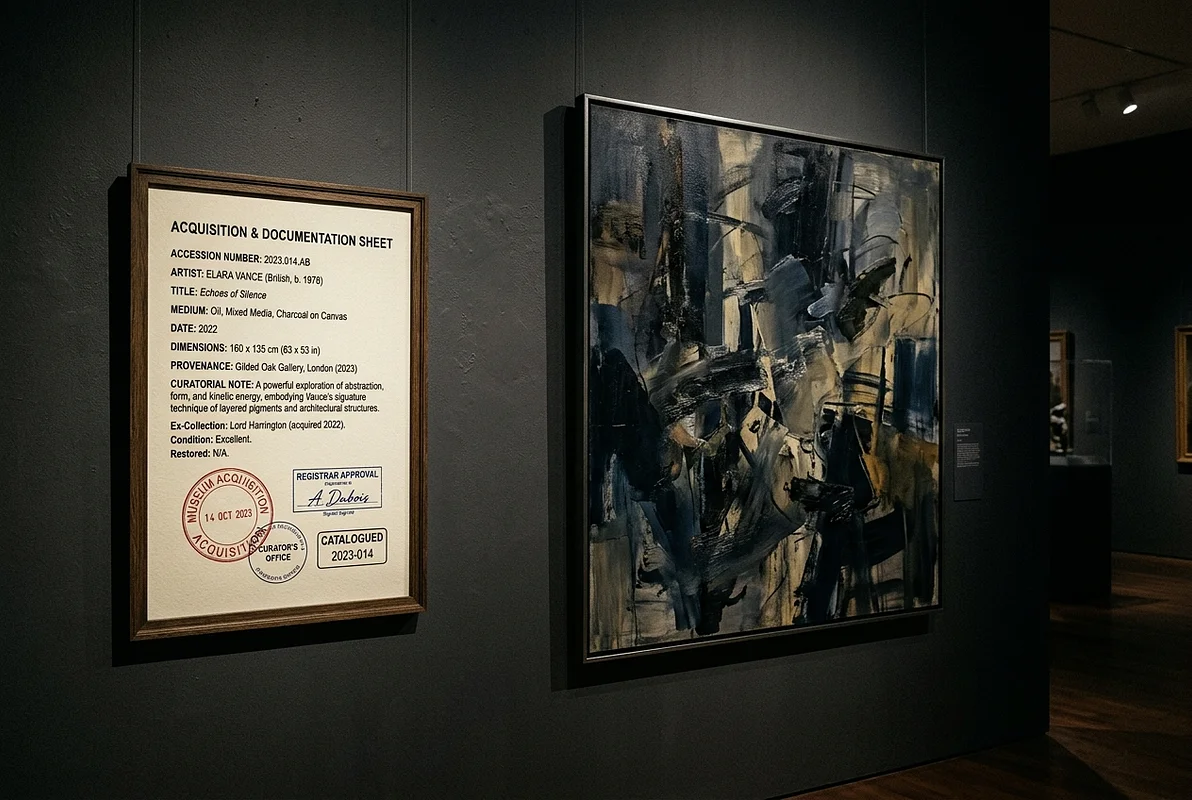
Artist name. The name you sign with. The name on your CV. The name on your website. If you work under a pseudonym, use that consistently. Museum systems find artists by name, and one spelling variation scatters your works across different database entries. One name. One artist. Everywhere.
Work title. In English and any other languages relevant to your market. Even if international sales seem distant, they'll come sooner than expected. Exhibition submissions, foreign buyers, digital platforms all require an English title. The title isn't a code—it goes into museum catalogues and auction records.
Year created. A specific year. A period if the work took multiple years (2024–2025). Not "approximately 2023". Dates matter. A 2023 work and a 2024 work have different historical contexts. One year's error scrambles your entire chronology.
Medium and materials. Not just "oil on canvas". Better: "oil on linen canvas with wooden stretcher". Even more detailed for museum records: which canvas preparation, how many paint layers, what tools. The more precision, the more confidence collectors have. Later, if the work needs care, a conservator has the information they need to preserve it properly. For prints: paper type, ink, technique. For sculpture: material (bronze, wood, stone, plaster) and method (casting, carving, modelling).
Dimensions. Height × width in centimetres—museum standard. For three-dimensional work, add depth. Include inches in brackets for international markets. Order matters: height first always. For unusual shapes, describe in words. The dimension system is the universal language of museums and galleries.
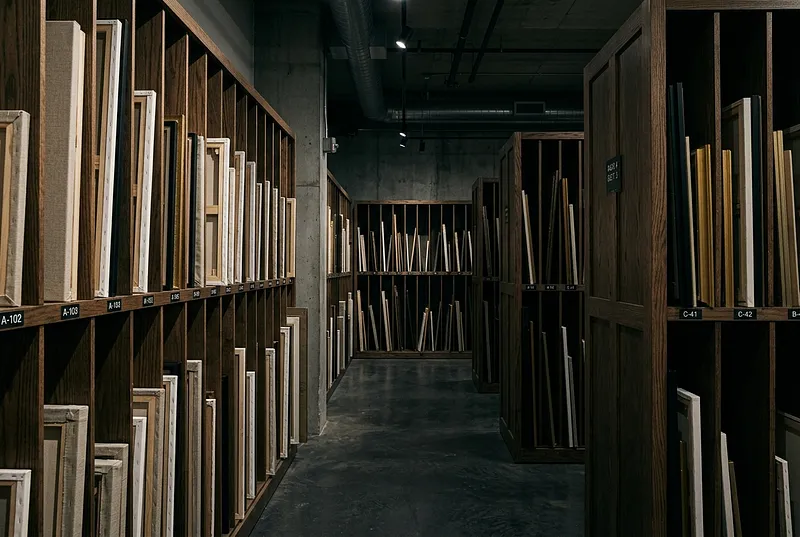
Inventory number. Your personal code identifying the work. With five works, it seems unnecessary. With fifty, invaluable. With five hundred, critical. This system helps you navigate your own archive without confusion. It's also how galleries track work on consignment.
Series or cycle. If the work is part of a series, note it. This provides context: the buyer sees not an isolated object but part of a larger statement. "Cities series No. 3 of 10" or simply "Cities, 2024". This shows sequence and intention.
Edition. For prints, photographs, digital work: "1/10" means first print of ten. "AP 2/3" means second artist proof. "Unique" means one only. "Unlimited" means unlimited. For paintings, not applicable. But if you produce editions, this is critical information for valuation and authentication.
Additional Details That Matter
Basic fields form the foundation. But a few extra lines transform a document into a real work biography. Note where your signature sits—front, back, or unsigned. Record current condition: visible age, wear, or need for care? This matters. A buyer who later discovers condition issues feels confident in your honesty. Include photographs: front, back, and details for complex works. Record current location: studio, gallery, storage, private collection. Note the current price (keep it private, but archive it). Document provenance—ownership history—which gains importance after the first sale.
These details aren't legally required. They transform the document from mere formality into a living work biography that will be valuable for decades. Conservators rely on these notes when they need to restore or examine a work years later. Galleries use them to track inventory. Museums reference them when cataloguing acquisitions.
Three Numbering Systems That Work
Your inventory number is your personal code. Choose one system and stick with it always. When you change systems, old numbers stay unchanged.
Year plus sequence: 2024-001, 2024-002, 2025-001. Simple, logical, chronologically sortable. Works for most artists. Downside: numbers get long over years.
Series abbreviation plus number: MEM-001 for "Memory" series, URB-003 for "Urban". Practical if you work in clear series. Downside: the system breaks down when you work outside series.
Initials plus year plus number: IK-2024-001. Useful for group exhibitions so your number doesn't mix with others'. Downside: longer to write.
Worst option: numbering differently for each work. Inconsistency guarantees chaos. In a year, you won't understand your own archive.
Where to Keep Your Passports
Minimum: a spreadsheet. Excel, Google Sheets, Notion, Airtable—anything where data is searchable and filterable. Add a column linking to photographs. This basic level works.
Better: a specialised platform. On Artfond, the passport generates automatically—you fill in the fields, upload photographs, and get a finished document with QR code. Saves hours on formatting.
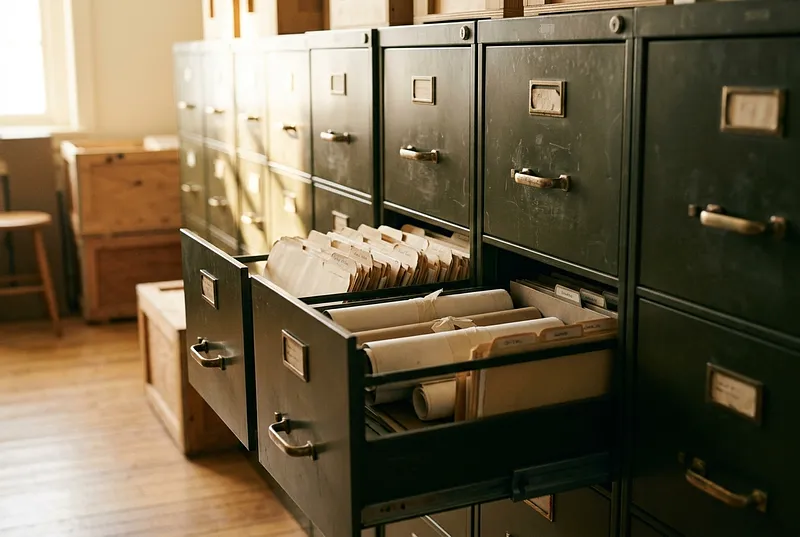
Ideal: digital catalogue plus a folder with printed passports for your most important works. Digital for daily work, searching, updating. Paper for moments needing physical documents: passing to a buyer, exhibition records, insurance claims.
One Rule That Solves Everything
No work leaves your studio without a completed passport. Not to an exhibition. Not to a buyer. Not temporarily to show someone. Never. It takes five minutes and saves hours later. This is workshop discipline that pays off immediately and compounds over years.
In a year, when you need details about a work from three years ago—dimensions for shipping, technique for a catalogue entry, the number for insurance—you'll be grateful for those five minutes. This counts in days you won't spend reconstructing information from nothing.
Passport as Career Foundation
An artwork passport isn't bureaucracy. It's the memory of your practice. Without it, in five years you can't prove authorship, value, or history. With it, each work has an identity, a name, a document that speaks for it. Passports are what museum collections, auctions, and private collections are built on. It all starts with you. With your decision to document from day one. And this choice becomes the foundation for everything that follows—from your first gallery conversation to eventual museum acquisition.