Without a Certificate of Authenticity, You Can't Sell Seriously
You sold the work. Buyer's happy, you're paid. Good. Ten years later, they decide to resell at auction and suddenly can't prove it's an authentic original. No documentation. No photograph. No serial number. The auction house won't catalogue it. Insurance won't touch it. And you can't even remember who bought it or where they are now.
A Certificate of Authenticity isn't bureaucratic formality. It's a legal document confirming: this specific piece is an authentic original by you. It protects both artist and buyer. It's a market standard you can't ignore if you want to work seriously. Without it, you're operating in the shadows of the art world, not in the light.
Without COA, Serious Buyers Won't Touch You
You're a collector considering £5,000–£10,000 for a painting. The artist says "Trust me, it's mine." You ask about a Certificate of Authenticity and their explanation collapses. No document. No number. No system. What happens? You move on to someone where everything is properly organised and professional. The transaction dies because the legal foundation doesn't exist.
COA isn't about distrust. It's about systems and professional organisation. Even if a buyer trusts you completely as a person, they need this document. For insurance purposes. For inheritance records. For reselling at auction five or ten years later. Any serious collector, gallery, or auction house checks for COA first. Its absence is a red flag saying: "This artist isn't ready for the professional market."
When you issue a quality COA, you're saying three things simultaneously. First: I'm organised. My work is tracked. I keep records. Second: my work is an investment asset worthy of documentation. Third: I'm ready for the professional art world, where standards matter. This changes absolutely everything in how other professionals and buyers perceive you.
What a Certificate Must Contain
Your full name and surname. Exactly as you position yourself professionally. If you work under an artistic pseudonym, use it consistently. Museums record artists by name, and one spelling variation scatters your works across different database entries. One name. One artist. Everywhere.
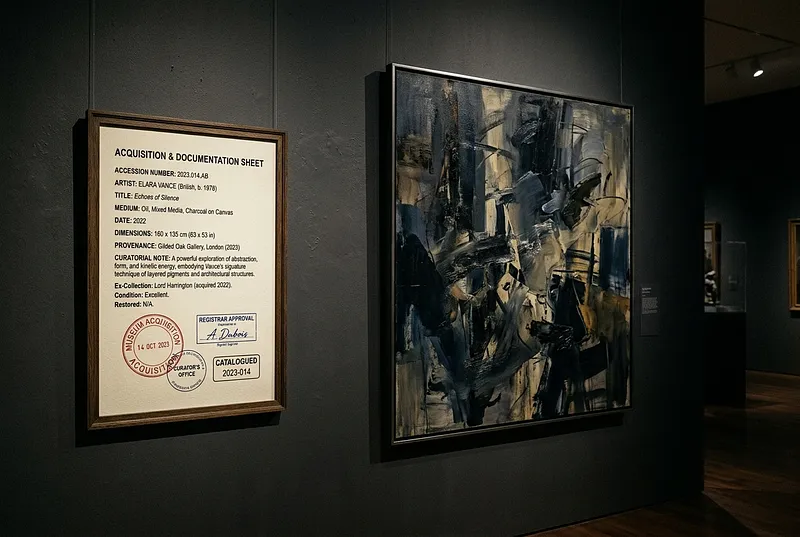
Work title, year created, medium and materials. Precision is critical. "Oil on canvas" differs fundamentally from "acrylic on canvas". Better still: "oil on linen canvas with wooden stretcher". Specificity demonstrates professionalism and helps conservators understand what they're working with.
Exact dimensions. Height × width × depth for three-dimensional work, height × width for flat work. In centimetres, with inches in brackets. Example: 80 × 100 cm (31.5 × 39.4 inches). This seems minor, but it speaks to professional standards at international level. Collectors and museums use this standard universally.
Unique inventory number. A number from your personal registry. Create a simple Excel spreadsheet with sequential numbering—discipline matters. For multiple copies note the edition: "3/25" means third print of twenty-five. For Artist Proofs: "AP 1/3".
Photograph of the work on the certificate itself. A small but clear, recognisable image for identification. This helps the buyer confirm in ten or fifteen years that this is actually the work they own. It's also essential for authentication if disputes ever arise.
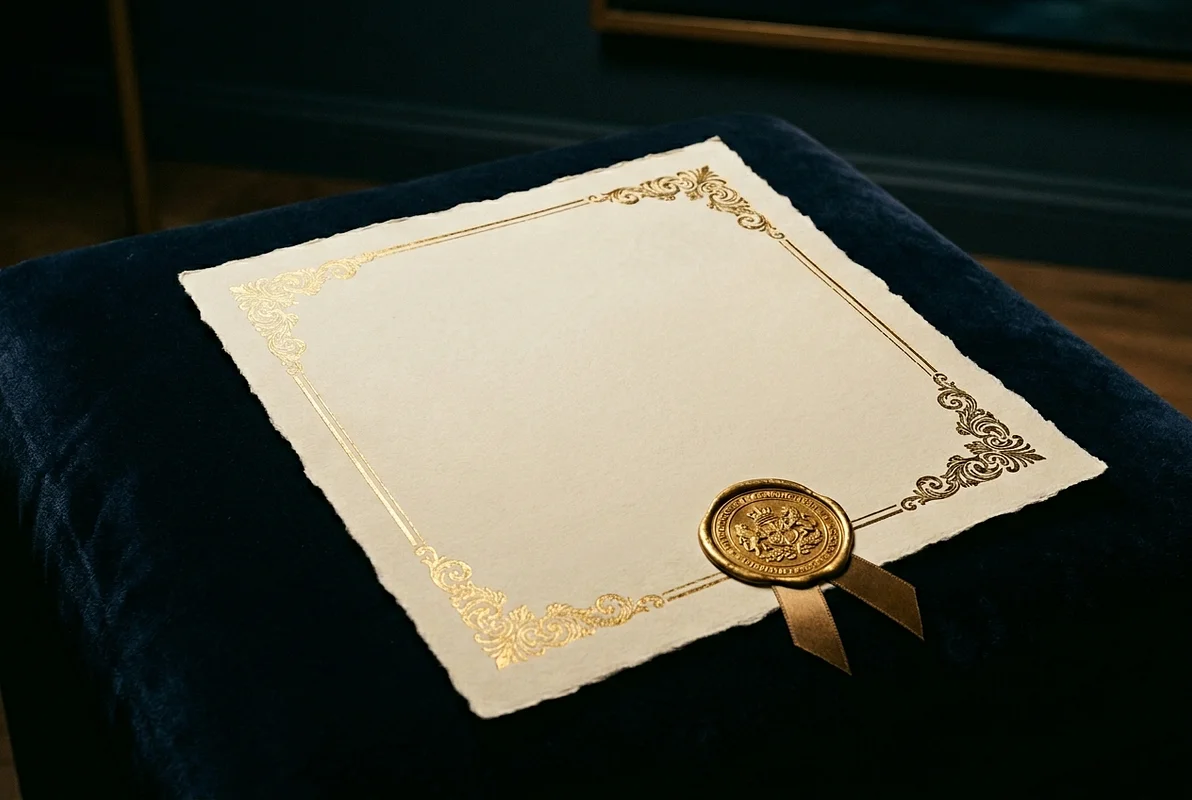
Certificate issue date. Your handwritten signature in ink. Some artists add holograms or security seals—not required, but useful protection against counterfeits, particularly as your work gains value.
Additional information: A QR code linking to your profile (Artfond, for instance), a unique certificate number, contact details—email, website, phone. This helps the buyer find you years later if questions arise about conservation or resale.
When and How to Issue
With every sale. Without exception. Your close friend. Fifty-pound work. Small print. Every single time. COA is the market standard—its absence is a red flag for any serious buyer.
Issue at the moment you transfer the work. The work and COA travel together, like a person's passport at a border. The buyer receives both simultaneously. Not next week. Not when they ask. Not eventually. Right then. This timing matters legally—the COA is part of the sale agreement.
Why COA Matters for the International Market
In professional art markets globally, COA carries particular weight. The international auction houses like Sotheby's and Christie's won't handle work without proper provenance documentation, which starts with a COA. When your work appears at international auction—increasingly common as collectors trade across borders—the presence of a properly issued COA increases realisation value by fifteen to thirty percent according to auction house research. Without it, even significant works sell at discount because bidders view unprovenanced pieces as risky. That's not a small difference when we're talking about thousands of pounds per work.
The COA also protects you against counterfeiting, particularly important as your career progresses. One authenticated work in a museum collection can spawn fakes. A numbered, photographed, digitally registered COA makes counterfeiting visible and actionable. This has happened to emerging artists whose work gained value; authentication systems with COA prevented market flooding with fakes.
Automation and Platforms
Creating COAs by hand for each work is tedious and error-prone. Platforms like Artfond automate this entirely: you upload the work, fill in details once, and the certificate generates automatically—with image, QR code, all mandatory fields, space for your signature. Print and sign by hand. If you use another platform or do it yourself, create a template in Adobe InDesign or even Microsoft Word with basic information in place. Change only specific details for each work. This saves hours and keeps consistency.
Keep copies in two places: digital in cloud storage, paper in a folder. Maintain a register—which work, which buyer, when, certificate number, buyer contact. A simple Google Sheet with columns for sale date, work name, buyer name, COA number, contact details. In ten years this database becomes invaluable—for museums enquiring about specific works and for documenting your entire career.
Final Thoughts
A Certificate of Authenticity isn't optional decoration. It's a fundamental document that makes your work part of a legitimate, serious art market. It protects you legally. It protects the buyer financially. It respects your work as an investment asset. Issue it always and without exception. Keep copies. Maintain a detailed register. This is the simplest and most effective way to build trust and protect your career for decades. Start with your next sale. Make no exceptions.
COA as Digital and Paper Document
In today's world, COA exists in both forms. The paper original goes to the buyer. But scan it and keep a copy. Better still: a digital COA can be uploaded to blockchain platforms if you create digital work or want to add a digital layer of authenticity. But even for purely traditional artists, digital copies of all issued COAs are critically important for archiving and documentation.
When you issue a COA, you're telling the world: I'm a serious artist. My works are valuable assets. I keep records. I'm ready for the professional art industry. A COA is a symbol of your credibility as an artist.