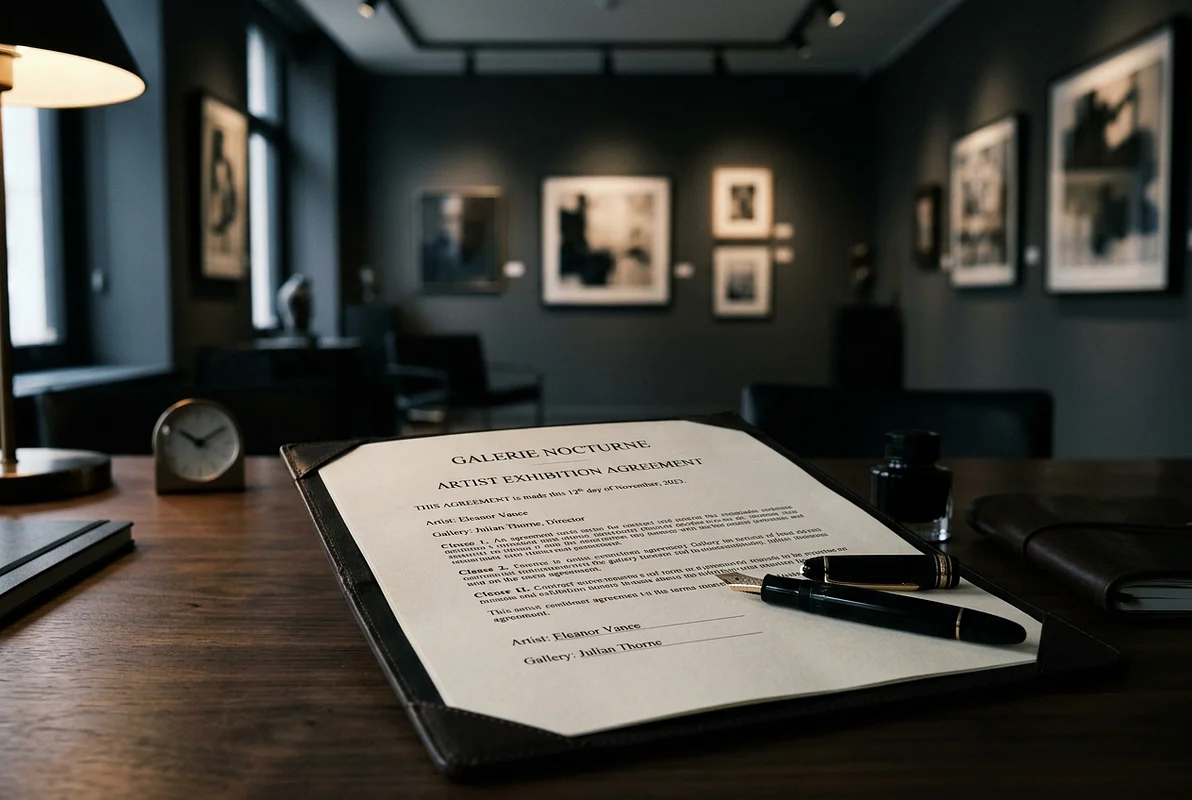
A gallerist calls with excitement. They want to show your work. "Let's sign the contract and get started," they say, moving fast. You sign without reading it. Without understanding it. You're nervous about asking questions. Worried about seeming difficult or ungrateful for the opportunity. That nervousness is the moment your career becomes vulnerable. A year later, you discover what you signed. The gallery holds representation rights to all future work for two years—everything you make belongs to their catalogue, not yours. Commission is 60%, not the 50% you thought you'd discussed. Works don't come back after the show closes; the gallery keeps them in storage "for future opportunities." Terms are intentionally vague. The contract you skipped reading became the instrument that shaped your career for months. This isn't rare. This is standard practice, standard exploitation, standard what happens when artists don't read documents.
A contract isn't formality or bureaucracy. It's the legal instrument that defines your relationship with a gallery and shapes your professional life. It's more powerful than a handshake or a promise. More powerful than a good conversation or an enthusiastic email exchange. You're binding yourself—your work, your time, your income—to specific terms. You must read it. You must understand it. You're not just clicking "agree to terms" on software. You're signing a legal document that can restrict your freedom for years. Read it carefully. Ask questions. Negotiate. Don't rush. A week spent understanding a contract is time well invested in protecting your career.
The essential clauses—what must be documented
Detailed list of works. This seems obvious until you realise how often it's missing. Specific titles. Dimensions. Materials. Creation dates. Not "works by the artist" vague and undefined. Not a casual list. Each work documented with images and detailed description. Include retail price for each piece so there's absolute clarity on what commission calculations are based. This prevents conflicts—you remember seven pieces in the show, the gallery claims twelve. List each one. Pin it down. Ambiguity almost always favours the gallery. Specificity protects you.
Exclusivity clause—narrow and limited, not absolute. This is where galleries often trap artists. Which works are exclusive to this gallery? All new works forever? Only pieces created specifically for this show? Can you sell through your website? Through other galleries? Exclusivity restricts your freedom to work. Make it narrow. Standard compromise: exclusivity applies only to works created after the contract is signed. Pieces you created before? Those stay under your control. Write it precisely in the contract: "Exclusivity applies exclusively to works created after the contract date. All pre-contract works remain under artist's ownership and control." This language matters. Vague language loses in disputes.
Commission and payment calculation—crystal clear. Standard is 50/50 split. Galleries might propose 60/40, 55/45, sometimes worse. Critical question: commission calculated from what price? From the full retail price the gallery displays? Or from a discounted price? If discounted, you lose money. Write it precisely: "Commission calculated from full retail price regardless of any discounts offered to buyers. If retail price is £1,000 and a buyer negotiates to £800, commission base remains £1,000. Artist receives £500, gallery receives £500." This language prevents the gallery from increasing their take by discounting. Pin down the number. Make it specific.
Payment terms—deadlines and penalties. When does money actually arrive? Week after a sale? Month? Three months? Some galleries hold money "pending receipt"—that's your interest-free loan funding their cashflow. Don't accept it. Write it: "Payment within 7 days of buyer payment being received by gallery. If payment is late, gallery pays 5% monthly interest to artist." Include penalties for late payment. Some galleries operate on slow timelines as business strategy. Make them financially uncomfortable doing that. Specific dates and penalties change behaviour.
Insurance and liability—critical protection. Who owns the work while it's in the gallery? The artist or the gallery? Who compensates if it's damaged, stolen, or destroyed? The gallery's verbal promise doesn't count in court. What matters is what's written. Write it: "Gallery insures all work at 100% of retail price. Gallery is solely liable for damage, theft, or loss while work is in gallery possession." Without this clause, a £10,000 piece gets stolen and the gallery says "sorry, uninsured" and you receive nothing. That's a catastrophe you must prevent in writing.
Term and termination—exit clarity. How long is this contract? Six months? One year? Forever? How do you exit? What notice is required? Watch for auto-renewal clauses—if you don't notify in 30 days, the contract automatically extends another year. That's a trap. Insist: the contract ends automatically unless both parties actively choose to continue. Simple language: "Contract term is 12 months from signature. Renewal requires written agreement from both parties signed by both. Otherwise contract ends automatically."
Work returns—specific timeline. After the exhibition closes, when does your work return? Week? Month? Year? Who covers shipping and insurance? Who determines packing standards? Write it precisely: "Works returned within 14 days of exhibition closing. Gallery covers all shipping and insurance costs using professional art handlers. Works packed to museum standards." Vague language gives galleries months to return work or excuses to keep pieces "for future opportunities." Specific dates matter. Professional standards matter. Write them down.
Clauses artists often overlook
Image rights and copyright. Who can photograph the work? The gallery only for promotion? For commercial licensing? Image rights are separate from commission rights. They're separate income. A gallery shouldn't be able to license your images to a design magazine, a coffee table book, or a corporate campaign without your permission and additional payment. Write it: "Gallery may use images for promotional materials and exhibition catalogues. Commercial licensing remains entirely artist property. Gallery cannot license images to third parties for any purpose without prior written artist permission and separate compensation."
Discount authority and who pays. Can the gallery discount work without asking? Most contracts say yes implicitly. But who pays for that discount? If the gallery discounts 20%, does it come from their commission or from your share? This matters enormously. A 20% discount on a £1,000 work means £800 proceeds. Is that split 50/50 from £800 or is it the gallery absorbing their entire commission? Write it: "No discounts without prior written artist approval. Discounts come entirely from gallery commission, not from artist share. Artist always receives agreed percentage of full retail price."
Sales reporting and transparency. Does the gallery tell you who bought your work? When? For what price? You have a right to know. That's your provenance. Your sales history. Your market documentation. Some galleries claim "confidentiality agreements with buyers" to avoid reporting. That's nonsense. You need this data. Write it: "Gallery provides monthly sales reports showing: work title, date sold, buyer name, sale price. Reports due within 10 days of month end." Without this, the gallery says "nothing sold" and you have no way to verify. Demand transparency. Insist on it in writing.
Red flags—what should make you walk away
Total exclusivity with no limits. The gallery owns all future work forever. You can't sell anything without permission. You can't show elsewhere. That's artistic servitude, not partnership. If a gallery insists on this, demand compensation: guaranteed monthly income, minimum sales commitments, or defined time limits. A confident gallery doesn't need total control. That demand signals desperation or exploitation.
No insurance clause. This is a deal-breaker. Work disappears, it's your loss. Never sign without insurance protection. Non-negotiable.
Auto-renewal without explicit exit mechanism. The contract automatically extends unless you notify by a specific date. You forget. You're locked in another year. Make exit explicit: contract ends automatically unless both parties sign a renewal agreement.
Commission over 60% without extraordinary justification. 60% is the ceiling for a standard gallery show. Higher commissions require specific justification—international art fairs, significant marketing spend, press coverage, international shipping, logistics. Otherwise it's exploitation. Know what you're trading for. Know if it's worth it.
Vague language throughout. Words like "appropriate," "reasonable," "standard," or "as needed" are dangerous. They look neutral until disputes arise. Then the gallery interprets them in their favour. Everything must be concrete and specific. "Reasonable commission"—specific. "Reasonable returns timeline"—specific. "Reasonable artist support"—specific. No vagueness.
How to read and negotiate
Read it three times. First pass: understand the gist. What are the main terms? Second pass: notebook in hand. Mark every point that confuses you, seems unfair, or makes you uncomfortable. Write questions. Third pass: hunt for vague language. Rewrite vague clauses into specific ones. Then ask. If something isn't clear, ask. If a clause hurts you, negotiate. If the gallery refuses to discuss and says "sign as-is or we move on"—that's a warning. Good partners discuss. You're negotiating business, not begging for opportunity. Many artists sign terrible terms out of fear or gratitude. Don't be that artist.
For significant contracts (ten works or more, £10,000+ value), show it to an art solicitor before signing. One consultation costs £150–300. That's cheap insurance against signing away your rights or income for a year. Art solicitors know the standard traps. They know which language hurts artists. They know which galleries consistently cause problems. A one-hour consultation is worth months of protection.
The contract as relationship foundation
A contract isn't hostile. It's the written foundation for a potential partnership—months or years of work together. But only if both sides understand what they're agreeing to. Read. Ask. Negotiate. Don't rush. Take a week. Take two weeks. A good gallery respects that. They want you to be comfortable and clear. A gallery that pressures you to sign quickly without reading? That's a warning. A good contract builds success and mutual understanding. A bad one builds resentment, limits your options, and steals your freedom. The time you invest in reading and negotiating pays back a hundred times over. Your career depends on these documents. Treat them accordingly.