Instagram could change its algorithm tomorrow at 7am. Your reach crashes from 30% to 5%. No notification. No explanation. No appeal. Your account could be blocked without warning—a glitch, an automated enforcement error, and you lose access. Platforms die. MySpace vanished. Tumblr collapsed. Vine is gone. Twitter's future is uncertain. But your email list is yours. 100% yours. No algorithm changes. No mysterious bans. No platform dying and taking your audience with it. Fundamental difference: you're playing by their rules versus rules you control. This matters more than you realise. Email isn't flashy. It's not social. But it's the only channel you own.
The numbers prove it. Email open rate for art averages 20–40%, often 30–50%, because subscribers are genuinely interested—they consciously clicked "subscribe" and took action. Instagram organic reach is 3–15%, typically 7%. Email reaches three to five times more people. Direct. Personal. Warm. And email converts four to five times better than Instagram. Email readers are ready to buy. They've already taken the first step. They've confirmed interest. That's dramatically different from Instagram where the algorithm decides what people see.
Building your list: the foundation
Where to collect emails. Your website—subscription form on every page. Artfond profile. At exhibitions and events: a sign-up sheet or QR code. People prefer paper lists to searching for links. Instagram bio link (Linktree or Artfond). In stories: mention that you "write things here I don't post on Instagram." Workshops and talks: invite attendees directly to subscribe. Master class participants? Email them the recording link and welcome them to the list. Every interaction is a potential subscriber.
But simple "subscribe to newsletter" fails. Conversion rates are 2–5%. Nobody clicks just to get on a list. People need a reason. A concrete incentive. This is a lead magnet—something valuable you offer in exchange for their email. For artists, specific magnets work: a PDF catalogue with work and prices (people want to know prices but feel shy asking directly). Exclusive first look at a new series 48 hours before public launch. Behind-the-scenes video of your process from start to finish. A guide: "How to choose a painting" or "How to care for artwork." A checklist: "10 things to look for when buying art." These work because they answer real questions people actually have but feel awkward asking face-to-face. They remove friction.
What to write: five content types that work
New work and series releases. Subscribers get first look. But not just an announcement. Tell them why. What inspired the series? How long did you spend on it? What changed in your thinking? Context makes work compelling. It tells a story. Stories sell better than objects.
Exhibition announcements—invitations, not broadcasts. Not: "I'm showing at Gallery X." Better: "I'm at Gallery X from the 15th to the 30th. Come. Cocktails. 7pm." Personal invitation beats corporate announcement. People want to feel invited, not mass-emailed.
Stories behind the work—deeper than Instagram. What inspired this series? What happened while making it? Difficulties? Breakthroughs? A collector's response that surprised you? People buy narrative, not object. They buy the story and the artist. Give them the story.
Exclusive offers—make subscribers feel VIP. Early access 48 hours before public launch. 10% subscriber discount. Commission options. Collaboration opportunities. Make them feel they've won something by being subscribers. VIP treatment drives loyalty.
Personal reflection—you, not your work. What's changed in your practice? What are you reading? Which exhibition shifted your thinking? A failure that taught you something? People subscribe for you, not your work. They follow your perspective, your thinking, your growth. Share that. Build connection.
Key rule: one email, one topic, one action. Don't overpack messages. One clear point per email. Better two short emails people actually read than one long email they abandon halfway through. When length grows, interest drops. People scan and skip. Keep it tight. Keep it focused. One message. One call to action.
Frequency: consistency over volume
Minimum monthly. Optimal two to four times monthly. Quality beats frequency. Don't email just to email. But if you have news, an exhibition announcement, a story—send it. Consistency matters. If you email weekly, your audience learns to expect it and checks. Once yearly, they forget you exist. Monthly signals you're active and serious.
The pattern matters more than the number. Find a rhythm you can sustain. Monthly is solid. Every other week is great. Weekly works if you have enough good content. The worst approach is erratic—sometimes weekly, sometimes silent for three months. That inconsistency kills trust and list growth.
Email structure: every section matters
Subject line decides if they open. Short. Intriguing. Specific. "New series: Quiet Mornings" works. "Newsletter #47" doesn't. "Why I'm stepping back from exhibitions this year" is better than "September update." Make them curious. Make it immediate and clear. If the subject doesn't make them curious or give them information they want, they don't open. That's the entire game.
Greeting: personal and warm. "Hello" or ideally by name (if your platform allows). Skip "Dear Subscribers"—that's corporate. Skip formal greetings entirely. Just start with the first sentence. "Hi," or "Hey," or just jump in. Warm. Conversational. Real.
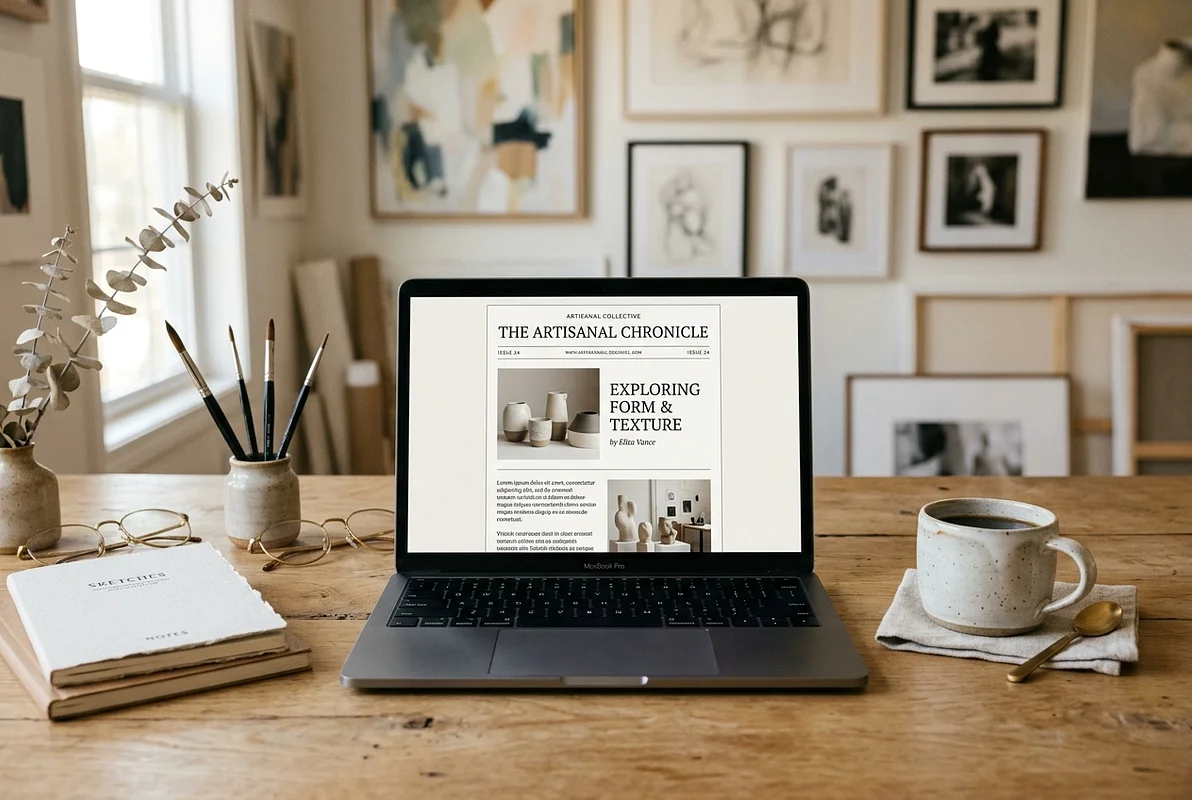
Main content: one idea, human language, one clear image. Write like you're writing to a friend. Talk like you're having a conversation, not marketing. Image mandatory—show your work, your process, your face, something visual. One image minimum, but images matter. A visual breaks text. It attracts attention. It makes the email memorable. One clear call-to-action at the end: click the link, reply to this email, visit the website, come to the show. Just one. Multiple calls-to-action confuse people. One direction focuses them.
Close and signature. Keep it simple. Your name. Website link optional but good. Maybe "Looking forward to hearing what you think" or "Reply to this email, I read them." Personal touch. Show you're a real person, not a robot.
Choosing your platform: do your research
Mailchimp. Popular for good reason. Free up to 500 contacts. Integrations work well. Templates are clean. Easy to learn. Good for starting.
MailerLite. Simpler interface than Mailchimp. Free up to 1,000 subscribers. Better automation features for small creators. Growing popular with artists.
ConvertKit. Built for creators. From £29/month. Worth the cost for automation and welcome sequences. Used by professional artists and creators.
Substack. Blog-letter format. People read and comment publicly. Community happens here. Takes 10% if you charge subscriptions. Good for writers and thinkers.
Brevo (ex-Sendinblue). European option. Affordable. Free up to 300 contacts. Good budget choice if you're cost-sensitive.
Choose based on where you'll actually stay consistent, not which has the most features. Simple and consistent beats advanced and abandoned. Start where you can manage easily. Upgrade later if needed.
What not to do—mistakes that destroy lists
Don't add emails without permission. Illegal under GDPR and similar laws. Unsolicited emails get flagged as spam. You damage your sender reputation. Build your list honestly, one person at a time.
Don't only sell in every email. "Buy this" in every message drives unsubscribes. Rule 80–20: 80% informational and valuable, 20% sales. Subscribers expect value. Deliver it. Then sales feel natural, not exploitative.
Don't ignore replies. A reply is a sale signal. Someone engaged enough to write back. Reply. Personal emails often lead to purchases or long-term relationships. Ignore them and you miss opportunities.
Don't dismiss small lists. Fifty engaged subscribers equal fifty potential buyers. Quality beats quantity. A list of 50 people who actually open your emails and care beats a list of 5,000 unengaged names.
Don't expect quick results. Email is a long game. Results come from months of consistency. First three months: maybe zero sales. You're building trust. When results come—and they do—email is the most stable channel. Instagram crashes. Algorithms change. Email lasts years and years.
Automation: email working for you
Platforms like ConvertKit and MailerLite let you automate sending. New subscriber joins? They instantly receive a welcome email plus your lead magnet (PDF, video, guide). You record it once, it works for everyone. Automated and scalable.
Advanced approach: welcome sequence of three to five emails. First email: welcome and lead magnet. Second: portfolio overview. Third: process story and your thinking. Fourth: exclusive subscriber offer. Fifth: call them to reply to start a conversation. Sequence sends automatically to every new subscriber over five days. This increases conversion 30–50% compared to a single welcome email. It's setup work once, then passive income and sales.
Segmentation: personalisation without extra work
When your list grows beyond a few hundred, divide subscribers by interest. Abstract-interested subscribers get emails about abstract work. Portrait-watchers get portrait emails. Commission-interested subscribers get commission information. Platforms automate this. Personalisation increases conversion significantly. But don't start segmenting at 100 subscribers—premature. Wait until you have enough to matter. Then segment. Then personalisation becomes relevant.
Analytics: listening to your data
Platforms show metrics: open rate, click-through rate, unsubscribe rate. If one email type gets 50% opens and another gets 20%, do more of the first. If people click "Belfast gallery visit" links heavily, they want exhibition news. Provide more. If they save process content but ignore sales emails, adjust. Analytics reveal what your audience actually wants. Listen. Respond. Adapt.
Email as your foundation
Instagram is flashy and fast. Email is steady and reliable. Email is the platform you own. The channel you control. Where your message lands in inboxes, not filtered by algorithms. Where you build direct relationships with people who care about your work. Start building your list now. Today. Add a subscription form to your website. Add a lead magnet. Collect ten emails. Then fifty. Then a hundred. Then email becomes your most stable revenue channel. Instagram crashes and burns. Email quietly sells your work for years.