An artist CV is a one- or two-page record of your exhibitions, education, residencies, awards, collections, and publications, each with a year, newest first. Galleries, curators, residencies, open calls, and grant panels ask for it alongside your portfolio and artist statement. Unlike a job resume, it has no skills, duties, or employers, only the places your work has been shown and selected.
An artist's CV is not a job resume
If you've sent a corporate job CV to a gallery—with sections on office skills, Excel proficiency, language courses, previous employers—don't panic. You're genuinely not alone. But artist CVs follow completely different rules. This is not a job application. It's your official record of artistic achievement. A corporate CV answers "what can you do?" Your artist CV answers "what have you already accomplished?" It's your professional timeline in the art world. When a museum curator reads your submission, your CV is first. Your CV must be absolutely clear. The stakes are higher than most artists realize.
Why CV format matters deeply
Artist CVs follow a standardized international format for one reason: it allows rapid scanning and comparison. Curators, collectors, residency panels, and competition judges read CVs very fast. They skim. They look for specific information in expected places. A well-organized CV that follows convention makes assessment easier. A creative format might feel more artistic—more authentic to your identity. But it actually makes evaluation harder. Busy professionals skip to the next artist. In this context, clarity and convention serve you better than originality. Originality belongs in your art, not in your documentation. Documentation must be functional.
Standard artist CV structure
Artist CVs follow an international standard. Galleries, curators, and institutions expect it. Deviating signals unprofessionalism. Don't experiment here—be clear.
Personal information. Full name (in capitals), birth year and place, current location. Email address (essential), website (essential). Phone number is optional. A photo isn't expected; if you add one, keep it a small portrait. A simple contact line underneath your name. This needs to be immediately clear.
Education. Year, qualification, institution, city. If you have formal art training, list it first. No training? Skip this section entirely. Many successful artists never had formal art school. That's fine. If you've done significant masterclasses with important artists or at important institutions, add a separate section labeled "Selected Training." This matters differently than degrees, but it matters.
Solo exhibitions. This is your most important section. Newest to oldest. Year, exhibition title, venue name, city. A solo show proves that an institution or gallery believed strongly enough in your work to give you a whole space. Whitechapel Gallery, Serpentine Sackler, MoMA—these change careers. Regional galleries matter too. Titles matter because they signal conceptual seriousness. "2024—Traces, Ingleby Gallery, Edinburgh" tells me something. Good exhibition titles show you're thinking conceptually.
Group exhibitions. Same format: year, title, venue, city. Long list? Be selective. Museum shows count more than unknowns. If you've had twenty or more group exhibitions, list only the strongest: museum shows, major international festivals, significant art fairs, prestigious biennial-type exhibitions. Ten strong group shows beat fifty weak ones. Quality over quantity. Curators know the difference between a museum group show and a group show in a unknown gallery.
Residencies. Year, program name, city, country. List competitive international residencies prominently if you have them. They're particularly valuable because they signal that you were selected through competitive peer review by people you don't know. A month at a prestigious residency like Skowhegan or MacDowell carries real weight. It shows experts thought your work was worth supporting.
Collections. Museum collections first—this is critical information. "National Gallery, London" or "Museum of Modern Art, New York" changes how people perceive you. Corporate collections matter too. Private collections? List generally if appropriate: "private collections in United States, Europe, and Asia." Collectors don't need identifying information.
Awards and grants. Year, award name, organization. Grants from recognized foundations matter because they mean experts selected you through competitive process. A Guggenheim, a NEA grant, major foundation support—these signal institutional confidence.
Publications. Work mentioned in museum catalogues, serious journals, art magazines? Note it. Year, work title, publication name. Museum catalogues matter significantly. Blogs and self-published material don't. Only serious publications. If your work has been written about in Artforum, Documents, or catalog essays from major exhibitions, that belongs here.
Artist CV example
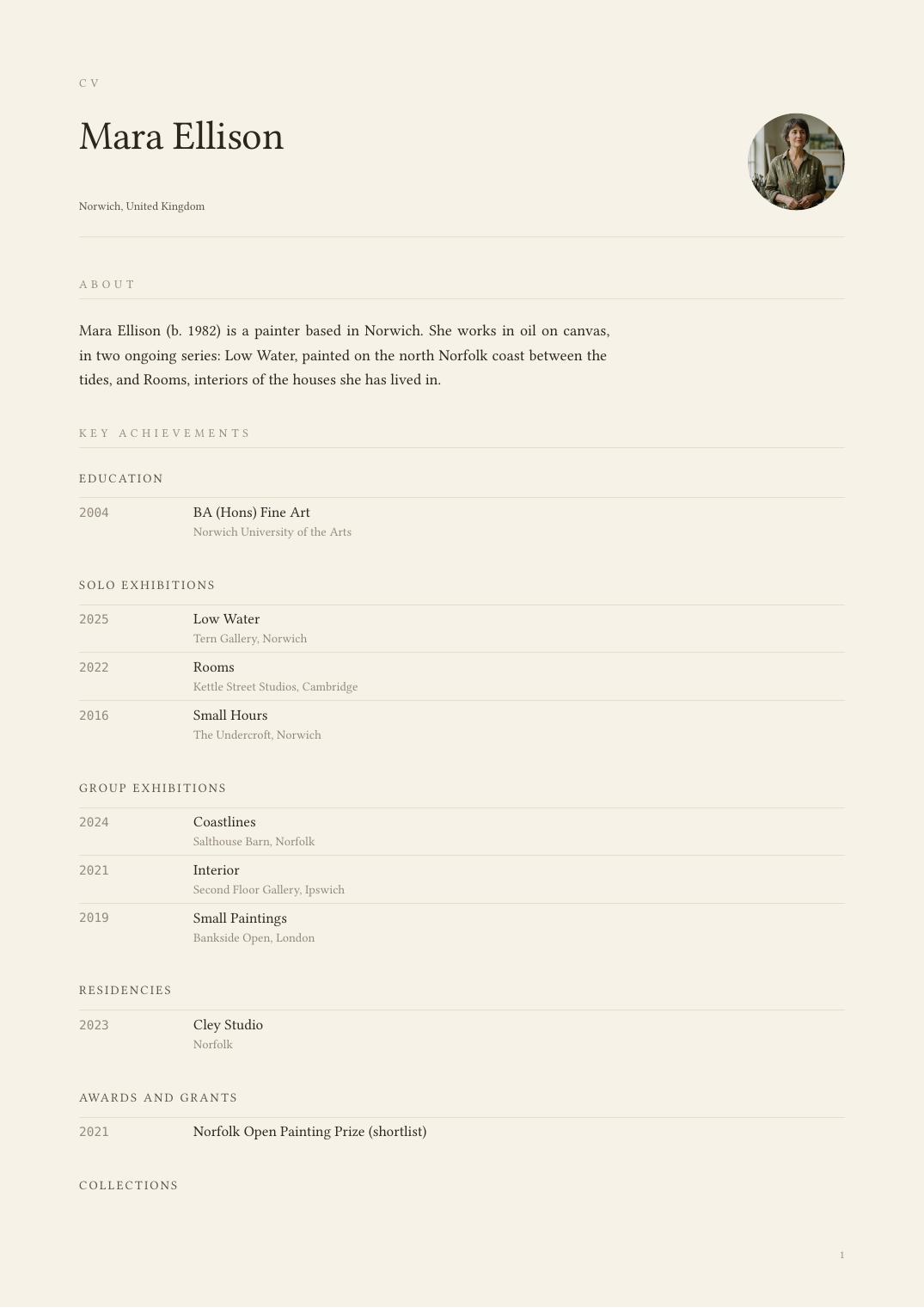
Here is a complete CV for a painter, in the standard order. Mara Ellison is a fictional artist; the details are sample data.
MARA ELLISON
b. 1982. Lives and works in Norwich, United Kingdom.
Email and website go on this line.
Education
2004 BA (Hons) Fine Art, Norwich University of the Arts
Solo exhibitions
2025 Low Water, Tern Gallery, Norwich
2022 Rooms, Kettle Street Studios, Cambridge
2016 Small Hours, The Undercroft, Norwich
Group exhibitions
2024 Coastlines, Salthouse Barn, Norfolk
2021 Interior, Second Floor Gallery, Ipswich
2019 Small Paintings, Bankside Open, London
Residencies
2023 Cley Studio, Norfolk
Awards and grants
2021 Norfolk Open Painting Prize (shortlist)
Collections
Private collections in the UK, the Netherlands, and Germany
Publications
2025 Low Water, exhibition catalogue, text by J. Harlow, Tern Gallery
Notice what isn’t there: no skills, no job history, no photos of the work. Each line is one fact: year, title, place.
Artist CV template
Copy this, replace everything in square brackets, and delete any section you have nothing for yet. Within each section, newest goes first.
[FULL NAME]
b. [year], [place of birth]. Lives and works in [city, country].
[email] · [website]
Education
[Year] [Degree], [institution], [city]
Solo exhibitions
[Year] [Exhibition title], [venue], [city]
Group exhibitions
[Year] [Exhibition title], [venue], [city]
Residencies
[Year] [Programme name], [city, country]
Awards and grants
[Year] [Award or grant], [organisation]
Collections
[Institution, city] or Private collections in [countries]
Publications
[Year] [Author], “[Article or essay title]”, [Publication or catalogue], [publisher]
What should never appear on your CV
Software skills. Don't list Photoshop, Maya, CAD, programming languages. Curators don't care about technical software. It's irrelevant to them. Your work speaks for itself regarding technical proficiency.
Unrelated work. You work as a designer, teacher, or have a day job to pay rent? Skip it unless it's art-adjacent. Exception: curatorial work, art teaching at college level, museum education positions, gallery employment—these belong. Teaching art history or running a gallery means something. Teaching high school math doesn't, even if you did it while building your practice. The exception: if you're curating exhibitions or running artist initiatives, that's professional activity worth listing.
Cancelled or unconfirmed shows. Don't list exhibitions that didn't happen or that fell through. Curators fact-check everything now. False information damages your credibility permanently. It's better to have a shorter accurate CV than a longer one with errors.
Old shows exclusively. Your last solo exhibition was in 2018 and now it's 2026? That eight-year gap screams inactivity. Four recent exhibitions beat ten old ones. Current activity signals you're still working, still relevant, still developing. History matters less than momentum.
The implicit competition
You're not just presenting a history. You're competing for attention and opportunities. When two artists with similar work apply for the same residency or exhibition, the one with the stronger CV typically wins. When a collector compares two emerging artists' work, the CV influences their decision about who represents better value, who has been vetted by institutions, who has stronger trajectory. The CV is strategic documentation. It's your argument—presented in standard form—for why people should pay attention to you and believe in your work.
Update it regularly and methodically
Your CV is a living document. It grows with your career. Many young artists hesitate to write one, thinking it will look embarrassingly short. Wrong. A concise current CV showing activity in the last two years is infinitely more valuable than a lengthy CV with a five-year gap in recent work. Current activity signals you're still working, still producing, still developing. Read your CV every three months. New exhibition? Add it immediately. Grant received? Add it. Major publication? Five minutes to update. Those five minutes might be the difference between yes and no when a grant panel or residency programme is evaluating your application.
Maintain a separate "CV Archive" folder on your computer. Collect scans of exhibition announcement letters, award confirmations, grant letters, publication copies, residency confirmations, museum acquisition letters—everything. Organize chronologically or by category. This serves two purposes. First, it simplifies updates. You know exactly what you've accomplished because you have documentation. Second, it provides proof when someone asks. A curator might verify: "Is your work really in the National Gallery collection?" You can send the documentation. A gallery might want confirmation of your residency dates. You have it. This archive protects you and strengthens credibility.
Your CV speaks for you when you're absent from the room. Make it clear, accurate, and confident. It's your official portrait in the art world.
Start building your CV today, even if it feels short. A young, active artist with five exhibitions is more compelling than an artist with thirty old shows and nothing recent. Activity matters more than history. Clarity matters more than length. Accuracy matters more than impression. Build it systematically. Update it consistently. It will become one of your most powerful professional tools.
Artist CV: frequently asked questions
What’s the difference between an artist CV and a resume? A resume makes the case for you as an employee: skills, duties, employers. An artist CV is a record of your exhibitions, education, residencies, awards, collections, and publications. Day jobs stay out unless they’re in the art world, such as teaching art, curating, or gallery work.
How long should an artist CV be? One or two pages for most artists. If yours runs longer, keep the full version for yourself and send a “selected” CV with the strongest entries in each section.
What order do the entries go in? Reverse chronological: the newest first within each section. Education, solo exhibitions, group exhibitions, residencies, awards and grants, collections, and publications is the usual order of sections.
What if I’ve only had a few exhibitions? Then the CV is short, and that’s fine. List what’s real, leave out empty sections, and add each new exhibition as it happens.
Do I need an art degree for an artist CV? No. Leave out the education section, or list significant courses under a heading such as “Selected training”.